


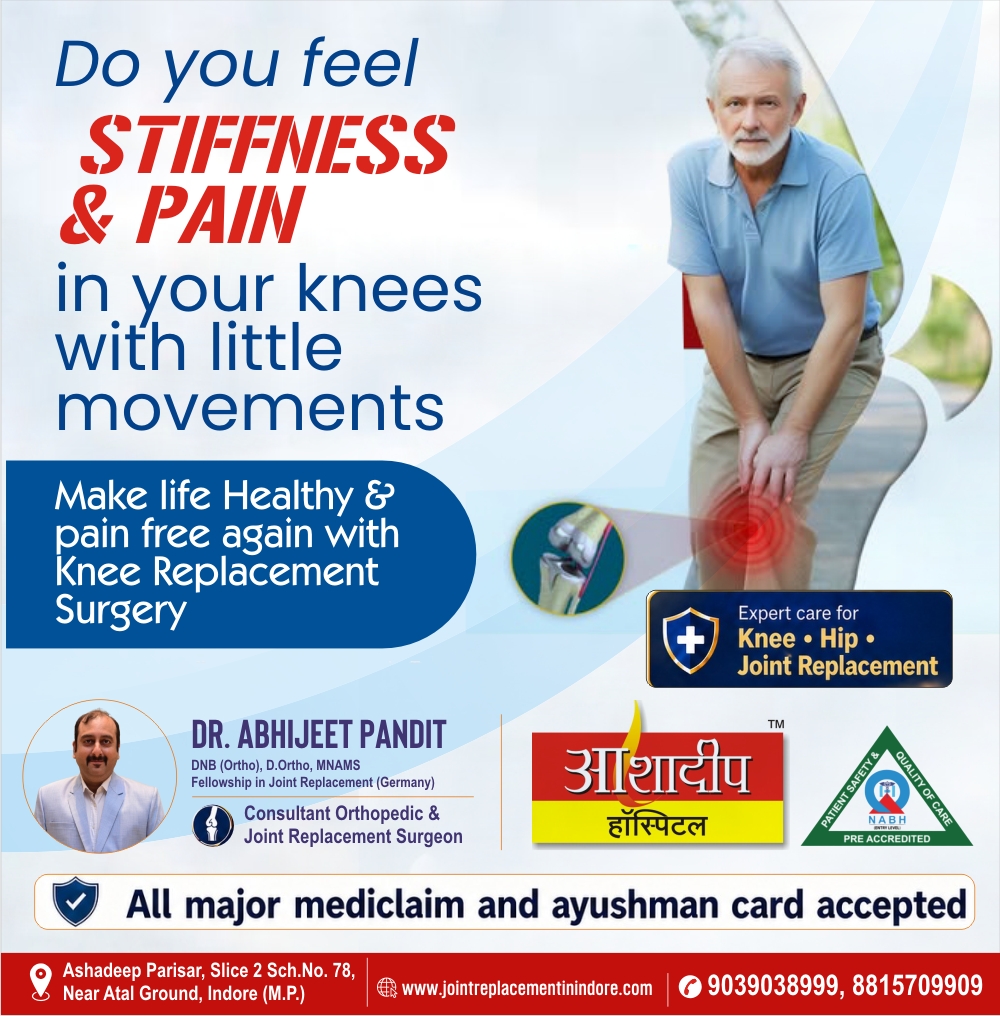
Knee Replacement Surgery in Indore: A Complete Guide to Pain Relief and Better Mobility
Persistent knee pain can affect far more than walking. It may make climbing stairs, standing from a chair, sleeping comfortably, travelling, exercising, and completing everyday responsibilities increasingly difficult. When knee damage becomes severe and conservative treatment no longer provides sufficient relief, Knee Replacement Surgery in Indore may be considered after a detailed orthopaedic evaluation.
Knee replacement is a planned surgical procedure in which damaged joint surfaces are replaced with specially designed implants. Its purpose is to reduce severe pain, improve joint function, correct certain deformities, and help patients return to a more independent lifestyle.
At Ashadeep Hospital – Dr. Abhijeet Pandit, patients can receive evaluation and personalised guidance based on the severity of knee damage, overall health, mobility limitations, and treatment history.
Knee replacement surgery, also known as knee arthroplasty, is performed to replace severely damaged portions of the knee joint with artificial components. These components are designed to create smoother movement between the thigh bone, shin bone, and, when required, the kneecap.
The surgery is not usually the first treatment for knee pain. Doctors commonly begin with non-surgical measures such as medicines, physiotherapy, activity modification, weight management, injections, supportive devices, or lifestyle changes. Surgery may be discussed when these options no longer provide meaningful relief.
The final decision depends on symptoms, examination findings, X-rays, medical condition, and the effect of knee pain on daily life.
A patient may be evaluated for knee joint replacement in Indore when pain and stiffness significantly affect routine movement.
Common situations include:
Age alone does not determine whether surgery is suitable. The decision is based on symptoms, joint damage, activity requirements, general health, and expected benefit.
Osteoarthritis is a common reason patients consider knee replacement treatment in Indore. It develops when the protective cartilage within the knee gradually wears down. As the joint becomes damaged, movement may cause pain, stiffness, swelling, and a grinding sensation.
Rheumatoid arthritis is an inflammatory condition that can affect the joint lining and cartilage. Long-term inflammation may lead to pain, instability, deformity, and reduced mobility.
A serious fracture, ligament injury, or previous knee trauma can change joint alignment and accelerate cartilage damage. Symptoms may appear immediately or develop years after the original injury.
Advanced arthritis may cause the knee to bend inward or outward. This can alter walking patterns, increase discomfort, and place uneven pressure across the joint.
Occasional knee discomfort may improve with rest and simple care. However, professional evaluation is advisable when symptoms become persistent or progressive.
Consult an orthopaedic doctor in Indore when you experience:
Early assessment does not automatically mean surgery. It helps identify the cause and allows patients to understand all available treatment options.
No. Many people with arthritis can manage symptoms without surgery, particularly during the earlier stages. The doctor may recommend a combination of:
Total knee replacement in Indore is generally considered when joint damage is advanced and non-surgical care no longer allows the patient to function comfortably.
In a total knee replacement, the damaged surfaces of the main knee compartments are replaced. It is commonly performed for widespread arthritis affecting most of the joint.
Partial or unicompartmental knee replacement may be suitable when damage is limited to one specific part of the knee. Patient selection is important because the remaining joint structures must be healthy enough for this approach.
A revision procedure may be required when a previous knee implant becomes loose, worn, infected, unstable, or damaged. Revision surgery is usually more complex and requires careful planning.
The most appropriate procedure can only be selected after examination and imaging.
Proper preparation can improve surgical safety and support recovery. Before the operation, the patient may undergo:
Patients should inform the medical team about blood-thinning medicines, allergies, previous surgeries, infections, dental concerns, and ongoing health problems.
During surgery, the damaged joint surfaces are carefully prepared and replaced with implant components. The surgeon checks alignment, movement, balance, and stability before closing the incision.
The exact surgical technique may vary according to the patient’s anatomy, severity of damage, implant selection, and surgeon’s clinical judgment.
The procedure is performed under appropriate anaesthesia. Patients are monitored closely during surgery and throughout the hospital stay.
When performed for the right patient and followed by proper rehabilitation, knee replacement surgery in Indore may provide several meaningful benefits:
Results vary between individuals. Recovery depends on health, muscle strength, rehabilitation participation, body weight, and adherence to medical advice.
Recovery is a gradual process rather than an immediate return to normal activity. Physiotherapy and patient participation play essential roles.
Soon after surgery, the healthcare team may begin:
After discharge, patients should follow instructions regarding medicines, dressing care, exercises, diet, activity, and follow-up appointments.
Helpful home preparations may include:
Physiotherapy helps improve knee movement, muscle strength, balance, and walking ability. Exercises should be performed according to the rehabilitation plan rather than being increased suddenly without guidance.
Consistency is usually more important than excessive effort.
Recovery speed differs from person to person. Many patients begin assisted walking shortly after surgery, but regaining strength, confidence, and smoother movement takes time.
The recovery period may be influenced by:
The surgeon and physiotherapy team can provide guidance based on individual progress.
Like every major surgery, knee replacement carries potential risks. These may include infection, blood clots, bleeding, stiffness, implant-related problems, nerve or blood-vessel injury, anaesthesia complications, or continued discomfort.
The medical team takes several precautions to reduce these risks. Patients can also support safer recovery by:
Immediate medical advice should be sought for high fever, increasing wound redness, unusual discharge, severe calf pain, breathing difficulty, chest pain, or sudden worsening of symptoms.
The goal of surgery is to make daily movement more comfortable. Many patients gradually return to walking, household activities, social outings, and low-impact exercise after receiving medical clearance.
Activities such as walking, stationary cycling, and certain supervised exercises may be encouraged. High-impact activities, repeated jumping, or heavy strain may not be appropriate for every patient.
Maintaining a healthy weight can reduce unnecessary pressure on the artificial joint. Regular exercise, balanced nutrition, and scheduled follow-up visits are also important for long-term joint care.
Choosing the right specialist involves more than searching for the lowest cost or nearest facility. Patients should consider:
A trustworthy knee replacement surgeon in Indore should recommend surgery only when it is medically appropriate and should explain non-surgical alternatives when they remain useful.
Two patients with similar X-rays may have different symptoms, activity levels, health conditions, and expectations. Therefore, treatment should not rely on imaging alone.
A complete plan considers:
At Ashadeep Hospital – Dr. Abhijeet Pandit, the evaluation process focuses on helping patients understand whether surgery is suitable and what they can reasonably expect from treatment and rehabilitation.
The primary keyword is Knee Replacement Surgery in Indore, referring to surgical treatment for advanced knee joint damage performed after specialist evaluation.
Surgery may be considered when severe pain, stiffness, deformity, and mobility limitations continue despite appropriate non-surgical treatment.
Yes. Physiotherapy helps restore movement, strengthen supporting muscles, improve balance, and support safer walking.
Both knees may be treated either together or in separate procedures for selected patients. The decision depends on health, joint condition, surgical assessment, and recovery capacity.
Living with severe knee pain can gradually reduce independence and confidence. When medicines, exercises, and other conservative treatments stop providing adequate relief, professional evaluation can help determine whether Knee Replacement Surgery in Indore is an appropriate option.
Do not delay assessment when knee pain repeatedly interferes with walking, sleep, work, or routine activities. A personalised consultation can help you understand the condition of your joint, available treatments, expected recovery, and necessary precautions.
Contact Us today to schedule an orthopaedic consultation and take an informed step toward improved mobility and a more active life.
| Tags: | #Knee Replacement Surgery in Indore |


