


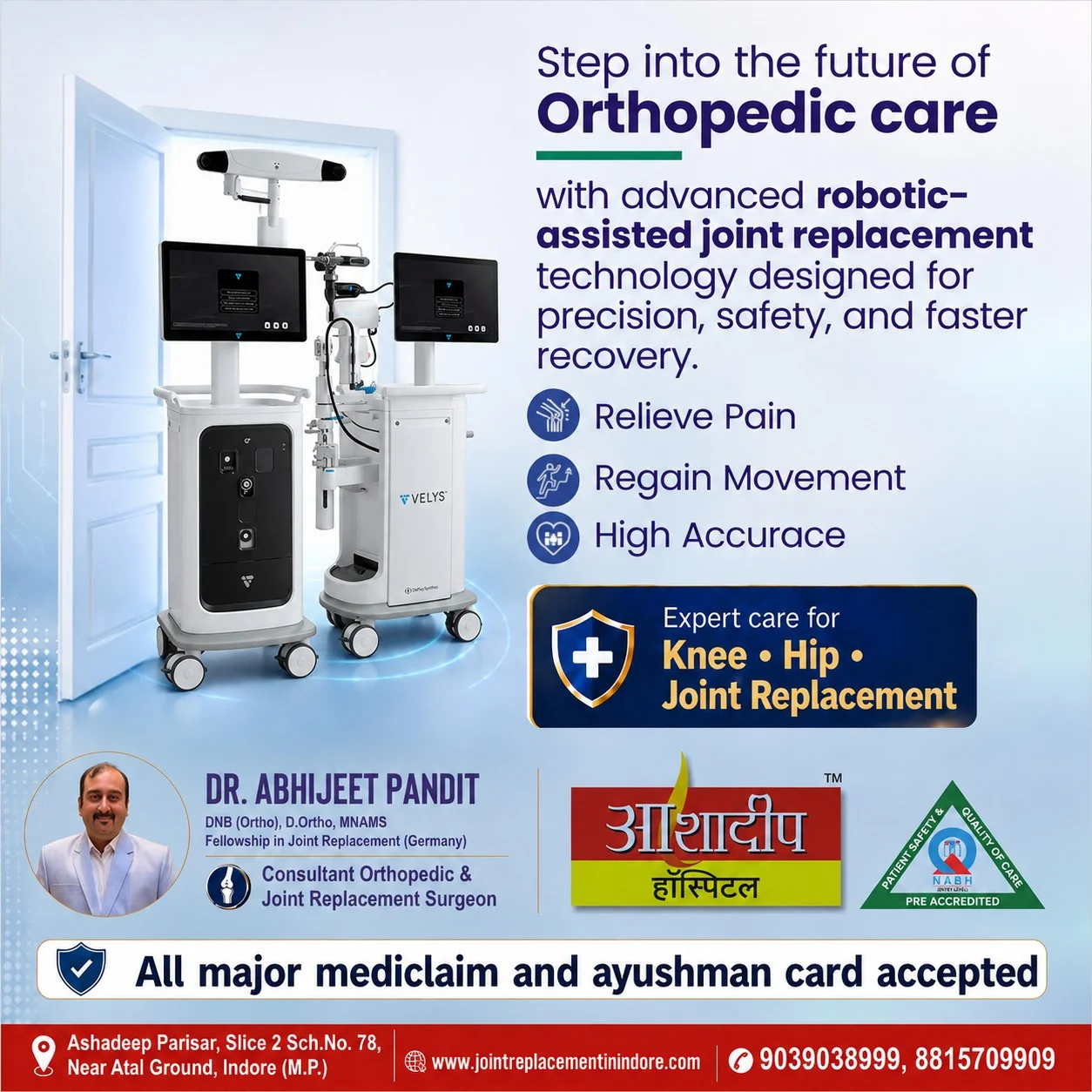
Joint pain can gradually affect walking, climbing stairs, sleep, work, and overall independence. When arthritis or severe joint damage reaches an advanced stage and non-surgical treatment no longer provides enough relief, joint replacement may be considered after orthopedic evaluation. Today, Robotic Joint Replacement in Indore is emerging as an advanced option for selected patients who need knee or hip replacement with technology-assisted surgical planning.
Dr. Abhijeet Pandit at Ashadeep Hospital provides orthopedic consultation and joint replacement care for patients dealing with severe knee pain, hip problems, arthritis, reduced mobility, and joint degeneration. Robotic-assisted systems are designed to support the surgeon with detailed planning and greater procedural precision, while the final surgical decisions remain under the control of the orthopedic specialist.
Robotic Joint Replacement is a technology-assisted approach used in certain knee and hip replacement procedures. It does not mean that a robot performs the surgery independently. Instead, the technology helps the surgeon plan and execute specific steps with improved accuracy based on the patient’s anatomy.
Depending on the system being used, robotic assistance may help with:
The exact benefits can differ from one patient to another, and suitability must be assessed individually.
The goal of any joint replacement is to replace damaged joint surfaces, reduce pain, and improve function in appropriate patients.
The addition of robotic technology may help the surgeon achieve a more individualized surgical plan.
Patients searching for Robotic Joint Replacement in Indore are often interested in the technology because it can assist with:
These potential advantages should always be discussed with an orthopedic surgeon because robotic assistance does not guarantee a particular outcome.
Joint replacement is usually not the first treatment for joint pain. Many patients can initially be managed with medicines, physiotherapy, weight management, activity modification, injections, or other conservative measures.
Surgery may be considered when joint damage becomes severe.
Common signs that may lead to an orthopedic assessment include:
An orthopedic consultation is needed to determine whether surgery is necessary.
The knee is one of the most commonly affected joints in osteoarthritis. Over time, cartilage may wear down, causing pain, stiffness, swelling, and reduced mobility.
Robotic Knee Replacement in Indore may be considered for suitable patients with advanced knee arthritis.
During the procedure, robotic technology can assist the surgeon in planning the replacement according to the patient’s individual knee structure.
A knee replacement assessment may be required in cases of:
Not every patient with knee pain requires surgery, so clinical examination and imaging are important.
Hip arthritis can make everyday activities such as walking, sitting, standing, bending, and getting out of bed increasingly difficult.
Robotic Hip Replacement in Indore may be used in selected cases to support implant positioning and surgical planning.
Hip replacement may be considered when there is:
A complete orthopedic evaluation is necessary before deciding whether robotic-assisted hip replacement is appropriate.
Both conventional and robotic-assisted joint replacement are performed by trained orthopedic surgeons.
The major difference is that robotic systems provide additional technology for planning, measurement, and guidance.
Traditional joint replacement relies on established surgical instruments, measurements, imaging, and the surgeon’s expertise.
Robotic technology adds digital guidance and can assist in carrying out a patient-specific surgical plan.
The surgeon continues to control the procedure throughout.
The best option depends on:
Preparation begins well before the day of surgery.
A patient being evaluated for Joint Replacement Surgery in Indore may undergo:
The orthopedic team may also explain the procedure, expected hospital stay, rehabilitation process, and precautions.
Recovery after joint replacement varies from patient to patient.
Factors influencing recovery include:
Depending on medical advice, patients may begin assisted movement relatively early after surgery.
Pain control, mobility exercises, and physiotherapy are important parts of rehabilitation.
Physiotherapy may focus on:
Patients should follow the rehabilitation plan recommended by their orthopedic team.
The primary aim of joint replacement is to improve quality of life in patients whose joint damage significantly affects daily activities.
Potential goals include:
Results vary, and no surgical procedure can guarantee complete pain relief or identical outcomes for every patient.
Robotic-assisted joint replacement is a surgical procedure and therefore carries general surgical risks as well as risks specific to joint replacement.
Possible risks can include:
The orthopedic team evaluates each patient’s overall health and explains relevant risks before surgery.
Selecting a surgeon should be based on medical expertise rather than advertising claims alone.
When looking for a Joint Replacement Surgeon in Indore, consider:
Ask about the surgeon’s experience with knee and hip replacement procedures.
A surgeon should understand both conventional surgical principles and the robotic system being used.
Each patient should receive an individualized assessment rather than a standard recommendation.
post-operative care and physiotherapy are essential parts of the overall treatment.
Patients should understand why surgery is being recommended, possible alternatives, risks, expected recovery, and realistic goals.
Do not wait for joint pain to completely limit your mobility.
You may benefit from an evaluation if you have:
Early evaluation does not necessarily mean surgery. It can also help identify non-surgical treatment options.
No. The orthopedic surgeon performs and controls the operation. Robotic technology acts as an assistance system for planning, measurements, and specific surgical steps.
Patients with advanced knee arthritis or severe joint damage may be evaluated for robotic-assisted surgery. Suitability depends on clinical examination, imaging, overall health, and orthopedic assessment.
Recovery time differs for every patient. Age, health, type of surgery, muscle strength, and adherence to physiotherapy can all influence rehabilitation.
Robotic assistance may be available for selected knee and hip replacement procedures depending on the system, patient condition, and surgeon’s recommendation.
Living with severe arthritis or progressive joint damage can make ordinary activities increasingly difficult. Modern orthopedic treatment aims to preserve mobility whenever possible and consider replacement surgery only when the joint has become significantly damaged.
For patients exploring Robotic Joint Replacement in Indore, Dr. Abhijeet Pandit at Ashadeep Hospital provides evaluation for knee and hip conditions, joint replacement options, and individualized orthopedic guidance based on the patient’s clinical needs.
If persistent knee or hip pain is affecting your mobility and daily routine, Contact Us Today to schedule an orthopedic consultation and learn whether robotic knee replacement, robotic hip replacement, or another joint treatment option in Indore may be appropriate for your condition.
| Tags: | #Robotic Joint Replacement in Indore |


